
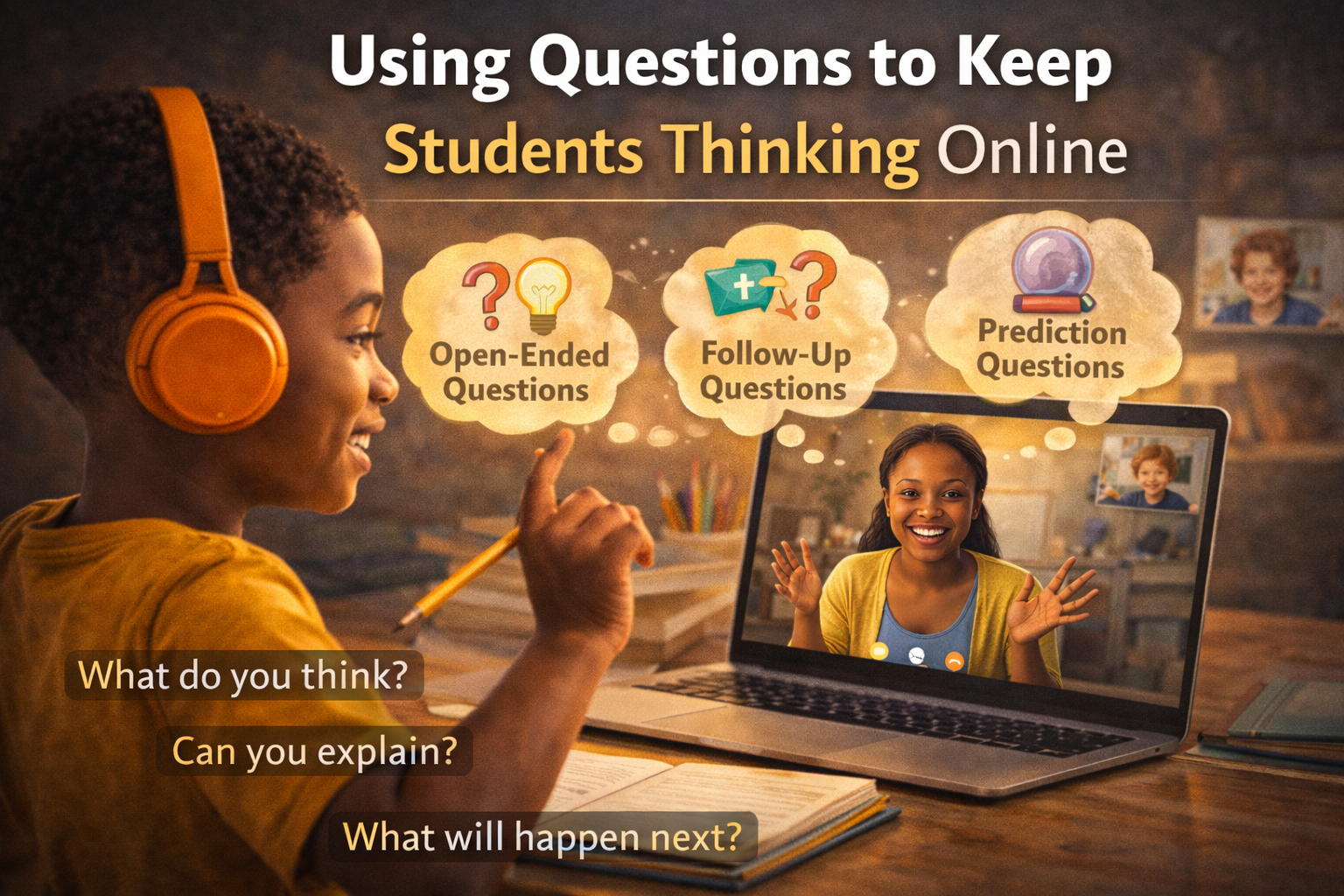
One of the biggest challenges in online learning is not teaching—it is thinking. Many students sit quietly in virtual classes, listening but not engaging, watching but not processing.
The most effective online teachers understand one powerful truth: questions keep the brain awake.
When used intentionally, questions turn passive learners into active thinkers.
Why Questions Matter in Online Learning
In a physical classroom, teachers can read body language and notice confusion. Online, this is harder. Questions become the bridge between the teacher’s voice and the student’s mind.
Good questions help teachers check understanding, spark curiosity, and keep students mentally present.
Questions Do More Than Test Knowledge
Many teachers ask questions only to assess answers. But questions are not just for testing; they are tools for thinking.
When students are asked to explain, predict, compare, or reflect, they are forced to process information instead of memorizing it.
Types of Questions That Keep Students Thinking
1. Open-Ended Questions
These questions do not have one correct answer. They invite discussion and creativity.
Examples include: “Why do you think this happened?” or “How would you solve this differently?”
Why they work: They encourage reasoning and expression.
2. Follow-Up Questions
Instead of moving on after a student answers, strong teachers ask follow-up questions.
Questions like “Can you explain your thinking?” or “What made you choose that answer?” deepen understanding.
Why they work: They push students to reflect on their thinking process.
3. Prediction Questions
Before revealing an answer or continuing a lesson, ask students to predict what will happen next.
This could be in a story, a math problem, or a science concept.
Why they work: They activate curiosity and focus.
4. Connection Questions
These questions help students link new learning to real life.
For example: “Where have you seen this before?” or “How does this relate to your daily life?”
Why they work: Learning becomes meaningful and memorable.
5. Reflection Questions
At the end of a lesson, reflection questions help students think about what they learned.
Examples include: “What was the easiest part?” or “What confused you today?”
Why they work: They build self-awareness and learning independence.
How Teachers Should Use Questions Online
Questions should be asked frequently, not only at the end of lessons. Teachers should also give students time to think before answering.
Silence is not a failure; it is often a sign that thinking is happening.
Encouraging all responses, even incorrect ones, creates a safe space where students are willing to participate.
The Real Goal
The purpose of questions is not to get quick answers, but to develop thinkers.
When teachers use questions intentionally, online learning becomes interactive, engaging, and effective.
Students stop waiting for answers, and start thinking for themselves.


